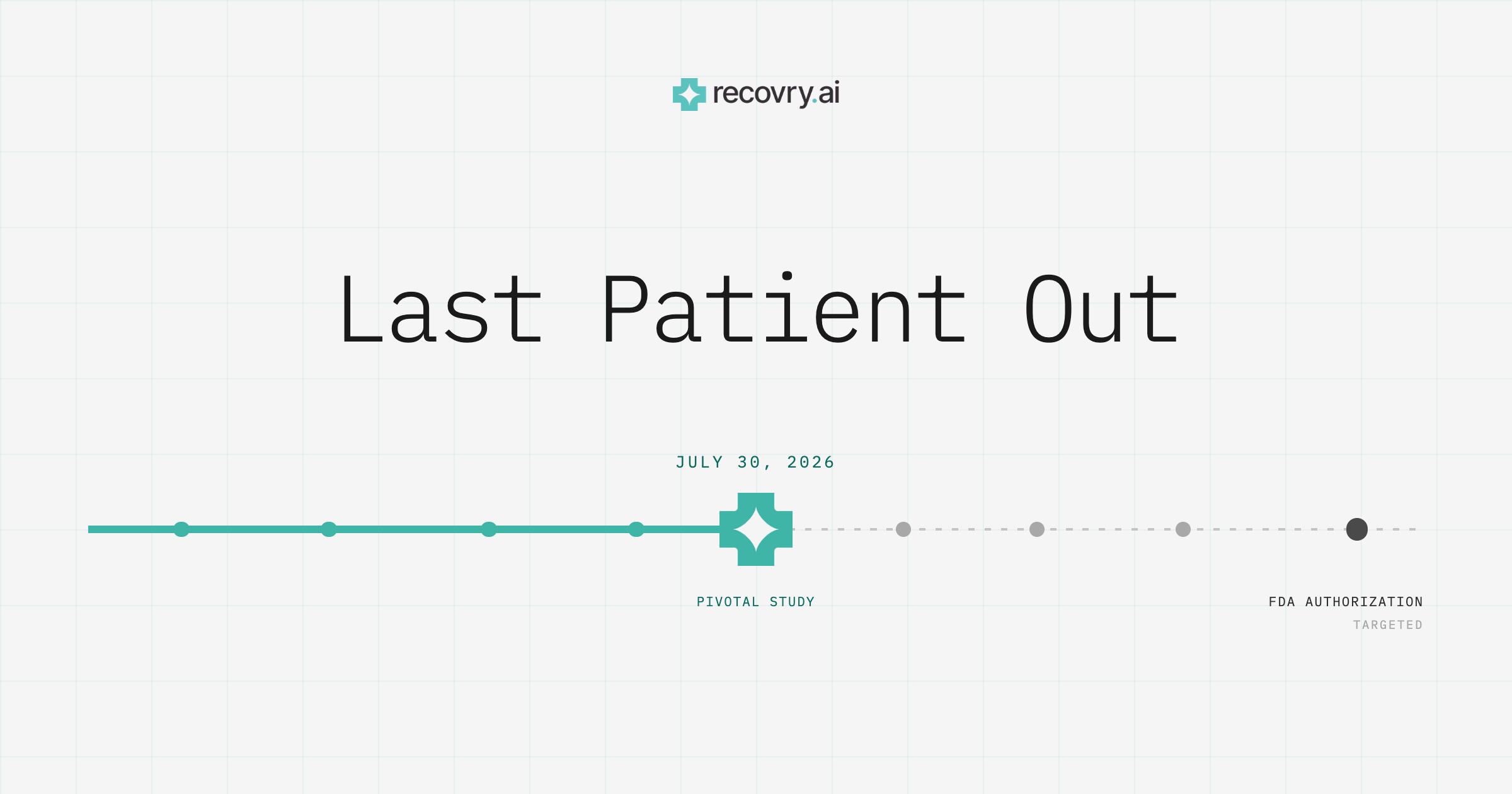
Today we notched one more important step into the mountainous climb to De Novo submission. With the final patient in our pivotal trial exiting the trial window – a moment labeled Last Patient Out (LPO) we’re now 100% complete with the clinical data collection phase of the trial. This is a really big deal. A full ⅓ of all pivotal trials never complete, mostly due to the immense complexities and expense of developing the protocol, recruiting the sites and physicians, enrolling patients, complying with institutional review board (IRB) guidelines, recruiting and deploying credentialed on-site coordinators, validating the statistical plan, running the trial, and myriad other details that make the process extraordinarily challenging.
We now enter the next major phase in our effort to obtain FDA authorization for our Virtual Care Assistant, and an immense amount of work still remains: physician adjudication (this will produce a staggering ~129,600 physician-reviewed clinical conversations between patients and orthopedic surgeons), final statistical analysis, human factors testing (another patient cohort to be recruited), cyber-security audit, quality controls documented, preparation of the De Novo submission package, and ultimately the FDA review during which we will respond to any of their requests.
Many of you have asked to be kept apprised of our progress. So, it seemed appropriate, considering today’s LPO, that this month’s Dispatch would take on the shape of an FDA De Novo submission primer that explains the regulatory pathway, where we are today, what’s ahead and why FDA authorization matters. For your reference, I’ve included a glossary at the end that might help you navigate the rhetoric. But first some grounding information for context.
Every stage described in this primer is tracked live on our FDA timeline: what is complete, what is in progress, and what could still change.
What we are building: Virtual Care Assistants
Our Virtual Care Assistant, or VCA, is software rather than a physical device (designated Software as a Medical Device - SaMD), and it’s regulated by FDA because it's designed to perform a defined clinical function independent of a licensed provider. The VCA engages directly with patients and independently manages routine postoperative patient interactions, proffering protocol-specific guidance when recovery appears as expected, identifies potential complications, and escalates deviations to overseeing care teams with complete clinical context.
There's no existing FDA-authorized device category that directly matches this functionality. What we’ve built has no predicate: procedure-specific, patient-facing clinical AI that performs routine clinical evaluation without requiring a licensed provider to review every interaction. That singular novelty is why we're pursuing the De Novo pathway.
Why De Novo rather than 510(k)
FDA generally reviews medical devices through one of three principal pathways.
A 510(k) submission is used when a company can demonstrate that its device is substantially equivalent to an existing legally marketed device, known as a predicate.
The De Novo pathway is intended for novel, low-to-moderate-risk devices for which no suitable predicate exists. Rather than demonstrating equivalence to an earlier product, the sponsor must establish that the device can be reasonably assured to be safe and effective for its intended use.
A successful De Novo authorization also creates a new FDA device classification. Future devices of the same type may then be able to use that classification and the authorized device as the basis for a subsequent 510(k) submission. However, similar devices seeking 510(k) authorization will have to prove “substantial equivalence” with our VCA.
A Premarket Approval, or PMA, is generally reserved for the highest-risk Class III devices and is not the pathway we are pursuing.
Our agreed-upon pathway is therefore a De Novo authorization as a Class II medical device.
Pre-submissions: Working with the FDA before the final filing
A De Novo submission filing shouldn't be the first time the FDA encounters the device, its architecture, its intended use, or its clinical validation plan. The FDA’s Pre-Submission program allows sponsors to request feedback before filing on matters such as:
- The proposed indications for use
- Clinical trial design
- Primary endpoints
- Statistical methodology
- Risk controls
- Technology architecture
- Safety and performance testing
- Special Controls
Since the fall of 2024, we've completed 8 rounds of Pre-Submission engagement with FDA, with at least one or potentially two additional pre-submission sprints anticipated before the final De Novo filing. This extensive level of communication, which is roughly three times the standard volume of interaction, is strategic. Recognizing the unique challenges of obtaining regulatory clearance for a novel patient-facing clinical AI without any precedent, we've actively sought feedback from the FDA. Through those interactions, we've progressively refined the intended use, clinical protocol, performance endpoints, statistical plan, safety framework, and the Agency’s understanding of the VCA’s operation. The extraordinary level of engagement with the Agency over such a protracted period is telling; we’re defining a new, and quite consequential device class.
This iterative process is a de-risking strategy. By exposing the Agency to our device, our approach to safety, transparency, post-market surveillance, and the myriad details of our architecture and technical components, we invite them to opine, ask for clarity, and indicate preferences – ultimately enabling us to uncover potential objections before we complete the final submission. By the time we file, nothing substantial should be new to the Agency.
Granted Breakthrough Device Designation
As you’re aware, in the first quarter of 2026, we announced that we received FDA Breakthrough Device Designation, which is granted to devices that the Agency believes have the potential to provide more effective treatment or diagnosis of life-threatening or irreversibly debilitating conditions and that meet specific statutory criteria. In other words, the designation reflects the Agency’s view that the device may offer meaningful clinical benefit if supported by adequate evidence.
The BDD program is designed to accelerate development and review by enabling more timely, interactive, and prioritized engagement with FDA. This can include earlier feedback, more frequent communication, and opportunities to resolve key questions before submission.
The practical value is earlier, more frequent, and more direct engagement with FDA reviewers as we develop the evidence package and prepare the De Novo submission. While this can help streamline the path to submission and review, FDA will still independently evaluate whether the final evidence demonstrates reasonable assurance of safety and effectiveness.
From pilot study to pivotal trial
A pilot study helps determine whether a clinical and statistical approach is workable. A pivotal study is the principal clinical study intended to support FDA’s determination of whether the device meets the applicable standard for authorization.
Before beginning the pivotal study, we completed a pilot involving 19 patients and greater than 500 conversations. The pilot helped establish the foundation for the pivotal protocol, including:
- The primary concordance endpoint
- The required pivotal-study sample size
- The physician-review methodology
- The adjudication process used to compare the VCA’s clinical judgment with that of orthopedic surgeons
The results exceeded the predefined pilot thresholds and supported progression to the larger prospective pivotal study.
Our pivotal trial was conducted under a Non-Significant Risk, or NSR, determination. The investigational device operated under physician oversight throughout. The NSR determination streamlined certain investigational oversight requirements, but it didn't reduce the rigor expected of the evidence supporting the De Novo submission.
The pivotal trial by the numbers
Our pivotal study included:
- 525 total hip and knee replacement patients completing the prospective study
- Three clinical sites
- Approximately 15 months of study activity
- More than 43,200 AI-patient clinical conversations
- Independent review by a panel of experienced orthopedic surgeons
- More than 129,600 individual physician assessments of the AI’s clinical recommendations
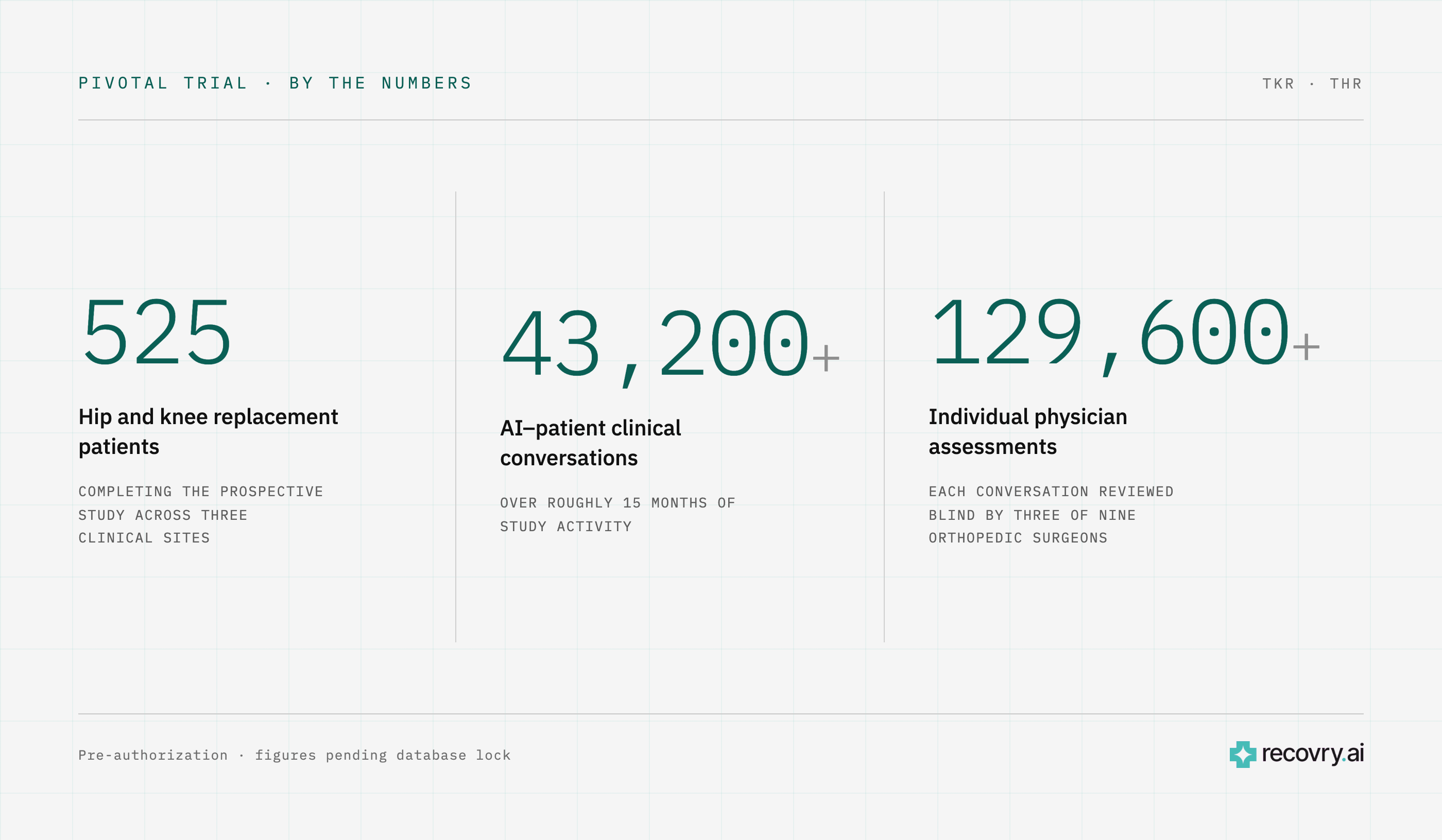
The study was conducted under institutional review board (IRB) oversight at three U.S. orthopedic centers: OrthoArizona in Scottsdale, Kansas Joint & Spine in Wichita, and Mercy Medical Center in Baltimore. Each eligible conversation is presented in a blinded format and reviewed independently by three physicians. The adjudication corpus will form the statistical foundation for evaluating whether the VCA met the study’s prespecified performance goals.
The prospective study is paired with a retrospective analysis involving 579 additional patients, bringing the total patient population evaluated under the protocol to 1,104. The retrospective component supports a secondary endpoint examining the VCA’s potential effect on clinical workflow and downstream healthcare utilization.
The protocol also includes a supplemental stress-testing dataset of approximately 1,500 conversations designed to evaluate the VCA against uncommon and clinically complex patient presentations that are difficult to capture at meaningful scale in a prospective study. These conversations were created through a proprietary controlled-generation framework that simulates combinations of clinical conditions, comorbidities, communication styles, and levels of literacy. Each generated conversation is anchored to a real, physician-adjudicated clinical interaction and independently validated for clinical plausibility before being used to evaluate the VCA.
Completing the patient trial means the full clinical dataset can be closed and analyzed. It doesn't yet mean that the study succeeded against its primary endpoints. That determination will come only after the remaining conversations have been adjudicated and the prespecified statistical analysis has been completed.
What happens next
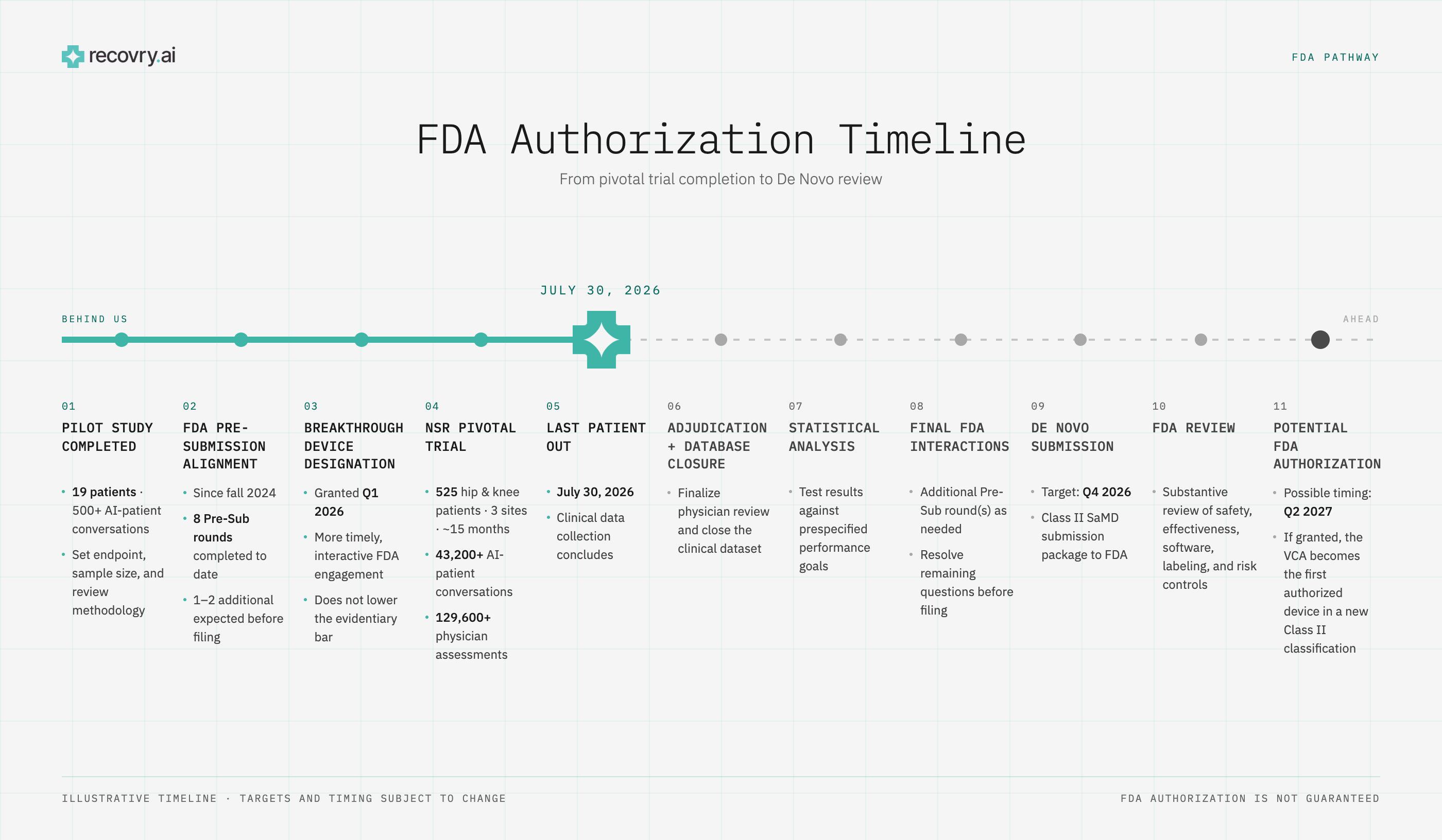
The path from Last Patient Out to a potential FDA authorization includes several additional stages:
- Final data collection and database closure. The study team confirms that the required patient data have been collected and resolves outstanding data issues, if any.
- Physician adjudication. The remaining clinical conversations are independently reviewed using the predefined multi-physician blinded adjudication methodology.
- Statistical analysis. The completed dataset is tested against the prespecified primary and secondary performance goals and statistical outcomes are calculated.
- Final FDA interactions. We expect to complete at least one or two additional Pre-Submission rounds to address remaining questions and continue aligning with FDA before the final filing. The decision determining how many Pre-Submission meetings are conducted is under our control.
- De Novo submission preparation. The clinical results are combined with the device description, software documentation, risk analysis, cybersecurity materials, human-factors work, validation testing, labeling, proposed special controls, and the predetermined change control plan (PCCP).
- FDA filing and substantive review. FDA evaluates whether the evidence provides reasonable assurance of safety and effectiveness for the proposed intended use.
- Final FDA decision. If FDA grants the De Novo authorization, the VCA would become the first authorized device within a newly established Class II classification. We're targeting our De Novo submission for the fourth quarter of 2026. Subject to the timing and course of FDA review, a decision could occur in the second quarter of 2027. These dates are targets, not guarantees. The scope of remaining work is substantial, and FDA may request additional information during its review.
Why completion of the pivotal trial matters
Novel-device programs frequently encounter two fundamental risks. The first is execution risk: the sponsor may struggle to recruit patients, operate the study consistently across sites, or complete the required follow-up. Fully one in 3 pivotal trials fail to conclude due to poor execution. The second is regulatory-design risk: the sponsor may complete a study only to learn that FDA does not agree that the endpoint, population, statistical plan, or evidence package adequately supports the intended use.
We've substantially reduced the first risk by completing enrollment and reaching Last Patient Out across three clinical sites. We've worked to reduce the second through repeated FDA engagement before and during the execution of the pivotal trial and evidence collection.
Neither accomplishment determines whether the VCA met the clinical performance bar. That is what the completed adjudication and statistical analysis must establish. But together, they place us in a materially stronger position as we prepare the De Novo submission.
FDA authorization is our capstone
FDA authorization would establish that the VCA may legally be marketed for a defined clinical use based on FDA’s review of its safety and effectiveness evidence.
That distinction is central to our proposition, and we strongly believe that the regulatory moat in healthcare is the most durable and defensible.
The VCA is intended to operate as an extension of the clinical team: managing routine, low-acuity patient interactions, identifying deviations from expected recovery, and escalating the cases that require further medical judgement. By intercepting routine clinical workload before it reaches licensed practitioners, the VCA has the potential to reduce the total volume of work that care teams must personally perform, not simply make that same work more manageable. Since the VCA is making clinical determinations independent of licensed providers, it's by definition a medical device, which requires FDA oversight.
FDA authorization would matter because it could:
- Distinguish RecovryAI from general-purpose health-information and conversational-AI products – introducing a new class of Prescribed AI
- Support the core economic thesis of reducing routine clinical workload without requiring licensed review of every interaction
- Establish a regulatory and clinical foundation that would require meaningful time, evidence, capital, and operational execution for competitors to reproduce
- Give physicians, health systems, and commercial partners greater confidence in deploying patient-facing clinical AI inside the care path because established insurance will cover its deployment in the same manner as other medical devices
- Create a potential multi-year competitive advantage based on authorization, clinical evidence, proprietary data, regulatory experience, and accumulated deployment knowledge
- Provide a platform from which we could pursue additional procedures, indications, partnerships, and future reimbursement pathways
- Align with outcomes-based reimbursement programs becoming the cornerstone of CMS’s future economics.
While FDA authorization wouldn't guarantee adoption, reimbursement, or commercial success, it would remove one of the most significant barriers to each and could give us an important head start in establishing the new patient-facing clinical AI category - Prescribed AI.
The completion of our pivotal trial is a monumental milestone, representing 15 months of clinical operations and the participation of hundreds of patients. We extend our deepest gratitude to the surgeons, their PAs, RNs, and support staff, our Clinical Site Coordinators, and our product team and leadership for their contributions to this success. As we look ahead, the most consequential work remains: completing adjudication, validating our endpoints, navigating final FDA interactions, and finalizing our De Novo application. We look forward to sharing further updates as the evidence becomes available.
Glossary of Terms
510(k): A premarket submission demonstrating that a device is substantially equivalent to an existing legally marketed device (a predicate). Not available to us, because no predicate exists for the VCA.
Adjudication: The blinded, independent review of each eligible AI-patient conversation by orthopedic surgeons, whose clinical judgments serve as the reference standard against which the VCA is measured.
Agency: Shorthand for the FDA — used when referring to FDA acting in its reviewing capacity (e.g., the Agency's feedback, the Agency's view of the evidence).
Breakthrough Device Designation: An FDA program granting more timely, interactive, and prioritized engagement to devices that may provide more effective treatment or diagnosis of life-threatening or irreversibly debilitating conditions. Granted to us in Q1 2026. It does not lower the evidentiary bar.
Class II: The moderate-risk FDA device class, subject to general and special controls. The classification we are seeking for the VCA.
Concordance: The degree of agreement between the VCA's clinical determination and the adjudicating physicians' determination on the same conversation. The basis of our primary endpoint.
De Novo: The FDA pathway for novel, low-to-moderate-risk devices with no suitable predicate. A grant both authorizes the device and creates a new device classification.
Endpoint: A prespecified, measurable outcome used to judge whether a study succeeded. Primary endpoints determine success or failure; secondary endpoints support additional claims. Endpoints must be defined, and agreed with FDA, before the data are analyzed.
Human Factors Testing: Validation testing that confirms intended users can operate the device safely and effectively as labeled. Requires a separate patient cohort.
Indications for Use: The formal statement of the clinical purpose, patient population, and conditions under which the device is authorized. Defines the legal boundary of marketing claims.
Institutional Review Board (IRB): The independent ethics committee that reviews and oversees a clinical study to protect participant rights and welfare. Our pivotal trial ran under IRB oversight at all three sites.
Last Patient Out (LPO): The point at which the final enrolled patient exits the study window, completing clinical data collection. Reached July 30, 2026. It closes the dataset; it does not establish that endpoints were met.
Non-Significant Risk (NSR): A determination that an investigational device study does not present significant risk to subjects, streamlining certain oversight requirements. Our pivotal trial ran under an NSR determination with physician oversight throughout.
Pilot Study: Ours involved 19 patients and greater than 500 conversations and set the endpoint, sample size, and review methodology.
Pivotal Study (Pivotal Trial): The principal clinical study intended to support FDA's authorization determination. Ours: 525 prospective patients, three sites, ~15 months, 43,200+ conversations.
Predetermined Change Control Plan (PCCP): An FDA-authorized plan, submitted with the device, that specifies modifications we intend to make to the device after authorization, along with the methods used to develop, validate, and implement them and an assessment of their impact. Changes made within an authorized PCCP do not require a new submission.
Predicate: A legally marketed device used as the comparison basis in a 510(k). The VCA has none — the reason we are on the De Novo pathway.
Premarket Approval (PMA): The most rigorous FDA pathway, generally reserved for highest-risk Class III devices. Not our pathway.
Prescribed AI: Our term for the emerging category of patient-facing clinical AI authorized to perform defined clinical functions under a clinician's direction.
Pre-Submission (Pre-Sub): A formal request for FDA feedback before filing, covering matters such as indications for use, trial design, endpoints, statistical methodology, and risk controls. We have completed eight rounds since 2024, with one or two more anticipated.
Primary Endpoint: The prespecified measure by which study success is judged. Ours is the concordance endpoint; secondary endpoints address workflow and downstream utilization.
Prospective / Retrospective: Prospective data are collected forward in time under the protocol (525 patients); retrospective data are drawn from existing records (579 patients), supporting a secondary endpoint. Total population evaluated: 1,104.
Reasonable Assurance of Safety and Effectiveness: The statutory standard FDA applies in a De Novo review — the sponsor must establish it affirmatively rather than by comparison to a predicate.
Software as a Medical Device (SaMD): Software intended for a medical purpose that performs that purpose without being part of a hardware medical device. The regulatory category the VCA falls under.
Special Controls: Device-specific requirements — labeling, performance testing, post-market measures — that FDA establishes alongside a new Class II classification. We propose them as part of the submission.
Sponsor: The entity that takes responsibility for a clinical investigation and the resulting regulatory submission — the party FDA holds accountable for the evidence, the conduct of the trial, and the claims made. RecovryAI is the sponsor of the pivotal trial and of the De Novo request.
Substantial Equivalence: The 510(k) showing that a new device is as safe and effective as a predicate. Once our De Novo is granted, later entrants would need to prove substantial equivalence to the VCA.
Virtual Care Assistant (VCA): Our SaMD product: procedure-specific, patient-facing clinical AI that manages routine postoperative interactions, identifies potential complications, and escalates deviations to the care team with full clinical context.
Regulatory status. Our Virtual Care Assistant is an investigational device, limited to investigational use, and is not approved or authorized for commercial use in the United States or any other country. Statements about timing, submission, and potential authorization are forward-looking and subject to change; they are not guarantees of any regulatory outcome.