A one-line formula from 1967 puts a hard ceiling on what assistive AI can do for medicine. Amdahl’s Law says the speedup of any system is capped by the fraction of the work you cannot speed up, and in clinical care the fraction that cannot be sped up is the clinical decision itself, made by a licensed human for one patient at a time. Scribes, copilots, and smart inboxes accelerate everything around that decision and leave the ceiling where it is. The only way past the ceiling is to shrink the part that stays serial: let a regulated device make the routine clinical decision itself and escalate the rest to a clinician. A second formula, Gustafson’s answer from 1988, predicts what happens next: the capacity does not sit idle, the care expands to fill it. RecovryAI is building this category, which it calls Prescribed AI, for post-surgical recovery; the device is investigational today and not authorized for commercial use.
In the spring of 1967, at the AFIPS Spring Joint Computer Conference in Atlantic City, an IBM engineer named Gene Amdahl stood up to argue against the future. Amdahl was the chief architect of the System/360, the machine that defined mainframe computing, and the future he argued against was the parallel computer: the idea that hundreds of processors working at once would deliver hundreds of times the speed. His objection fit in a sentence. Every job contains a part that must run in sequence, one step after another, and no amount of parallel hardware touches that part. Speed up nine tenths of a job infinitely and the whole job runs at most ten times faster. Speed up half of it infinitely and the ceiling is two. The fraction you cannot parallelize sets a hard limit on everything you can. Computer scientists have called it Amdahl’s Law for almost sixty years, and it has never stopped being true.1
Last month I wrote about two economists, Baumol and Jevons, and what they reveal about the cost of clinical care.2 Baumol found the trap in wages. Amdahl found the same trap in time.
The Clinician’s Day, Divided
Every clinician’s day splits into the same two parts Amdahl saw in a computing job. There is the work around the decision: the note, the chart review, the inbox, the callback, the referral letter, the coding. And there is the decision itself: a licensed human looking at one patient’s situation and making a clinical judgment about it. The first part can be parallelized, delegated, and accelerated. The second part runs in sequence, one patient at a time, because the judgment is the human effort itself.
The proportions are measured. In 2016, Christine Sinsky and colleagues published a direct-observation study in the Annals of Internal Medicine: for every hour a physician spent face to face with patients, nearly two more hours went to the electronic health record and desk work.3 Two thirds of the day is the work around the decision. One third is the decision.
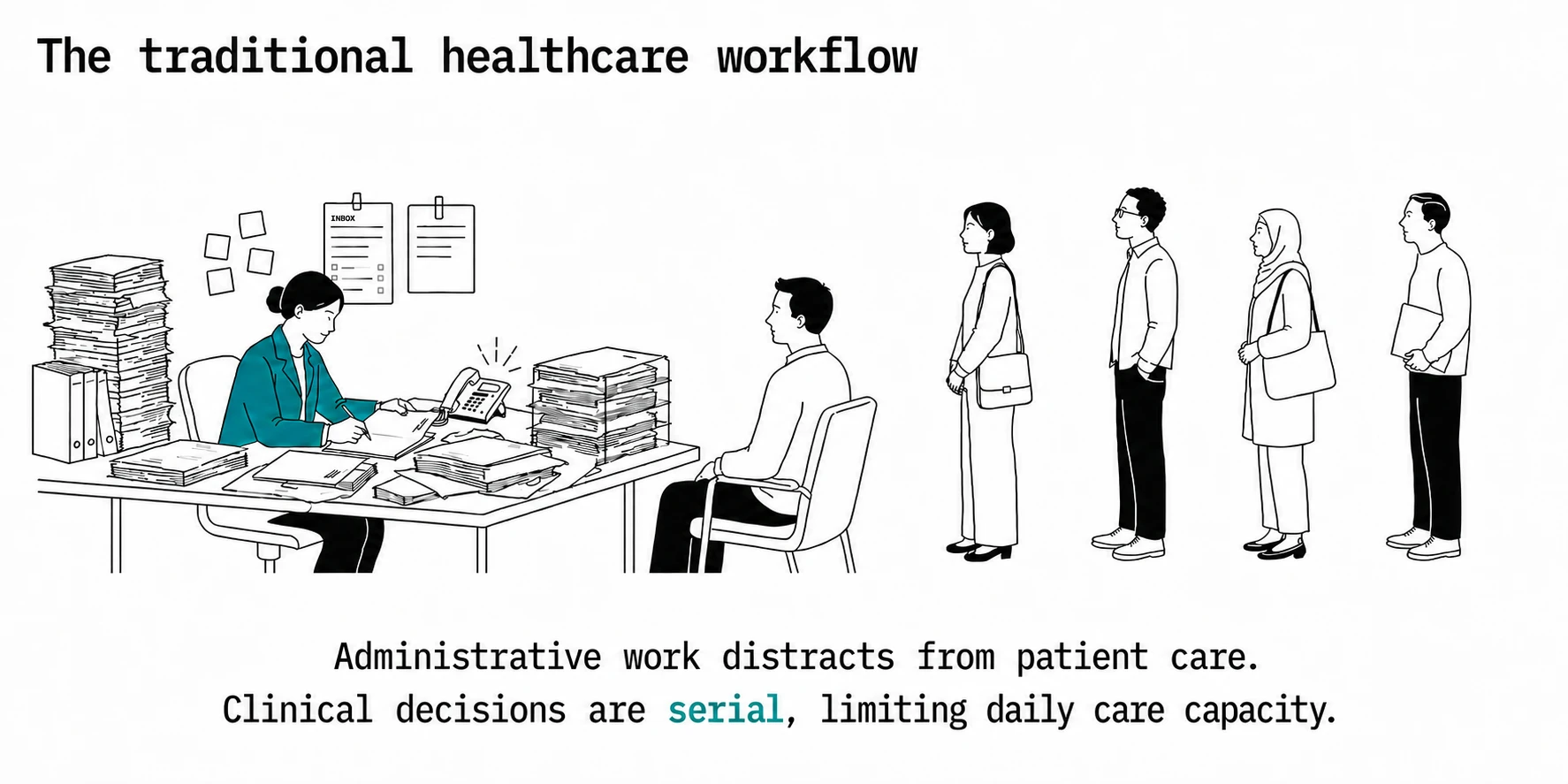
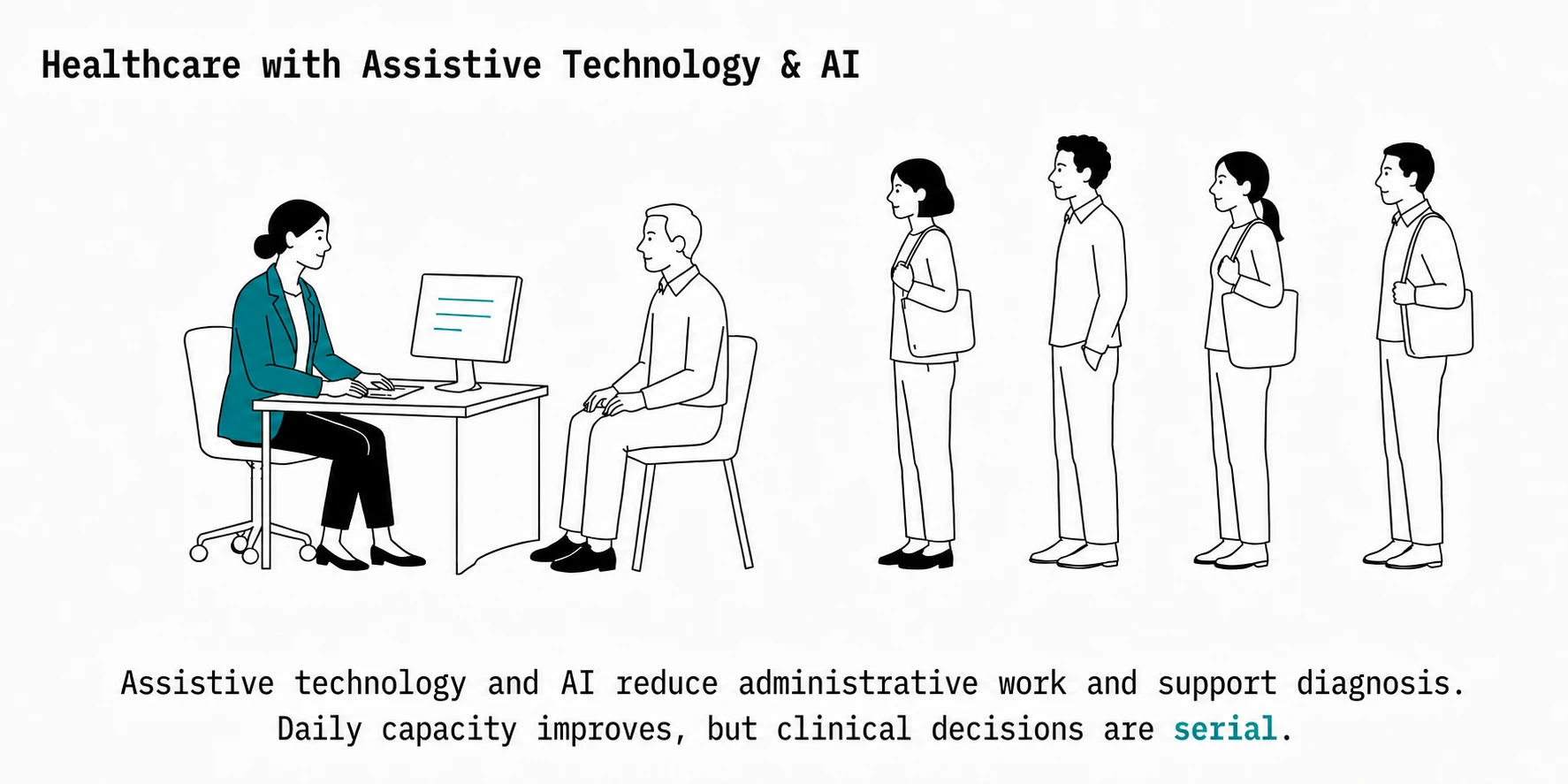
Run those numbers through Amdahl’s formula and you get the ceiling on the entire assistive-AI project. Erase every desk hour, every note, every inbox message, perfectly and instantly, and a clinician’s day holds three times the patient judgment it holds today. Three is the absolute limit, reachable only by deleting the around-work entirely. No tool comes close. The best evidence on ambient scribes, from roughly 1,800 clinicians across five academic medical centers, found about 16 minutes of documentation time saved per eight hours of patient care, a gain of around three percent.4 A Stanford team measured what happened when 162 clinicians let a language model draft their patient-message replies: reply time, read time, and write time did not change at all, though burnout scores fell.5 The tools are real, the relief is real, and the arithmetic is unmoved.
Meanwhile the workload on the other side of the ledger doubled. At one high-volume orthopaedic practice, post-operative communication per knee-replacement patient rose 105 percent in six years.6 Demand for clinical judgment is compounding. The ceiling on making the judge more efficient is three, and the industry is harvesting three percent.
Optimizing Toward the Ceiling
Amdahl’s Law has a second, crueler property: the closer you get to the ceiling, the less each improvement buys. Once the parallel part of a job is fast, further speeding it changes almost nothing, because the serial part now dominates the runtime. Chip designers lived this for decades. Healthcare AI is beginning to live it now.
Each new assistive tool shaves the same shrinking fraction. The scribe writes the note faster; the copilot summarizes the chart faster; the inbox triages itself. Every one of these products competes to accelerate the two thirds of the day that Amdahl’s formula says cannot deliver more than a bounded, diminishing return, while the serial third, the decision, sits untouched at the center of the day, setting the limit for the whole system. The investment flowing into healthcare AI is, in large part, capital optimizing toward a ceiling.
This is no argument against the tools. A practice should use them, the way a programmer should still speed up the parallel code. It is an argument about where the limit sits, and about what kind of system is required to move it.
The Move That Changes the Equation
Amdahl’s Law offers exactly one escape, and every computer architect knows it: shrink the serial fraction. Take work that ran in sequence and give some bounded piece of it to the machine. The formula does not care how fast you make the parallel part; it cares how much of the job still has to wait in line.
In clinical care, shrinking the serial fraction means a machine making some bounded share of the clinical decisions themselves. Most of what reaches a surgical team after a knee or hip replacement is one question asked over and over: is what this patient feels part of normal healing, or the first sign of something wrong? The expected pain, the swelling that is on schedule, the wound that looks worse than it is, the medication question that comes up in nearly every recovery. Each answer is a clinical judgment, and today each one waits in the serial line for a licensed human.
A system that can answer the routine form of that question reliably, prove that it answers reliably, and recognize the case that is not routine, takes that slice of the judgment out of the line. We call it a Virtual Care Assistant. It is designed to resolve the routine recovery question in the moment it is asked and to escalate the exception to the care team, a move aimed at the serial fraction rather than the parallel one. A question resolved that way never enters the queue: no message in the inbox, no callback, no note to sign. The ceiling itself moves.
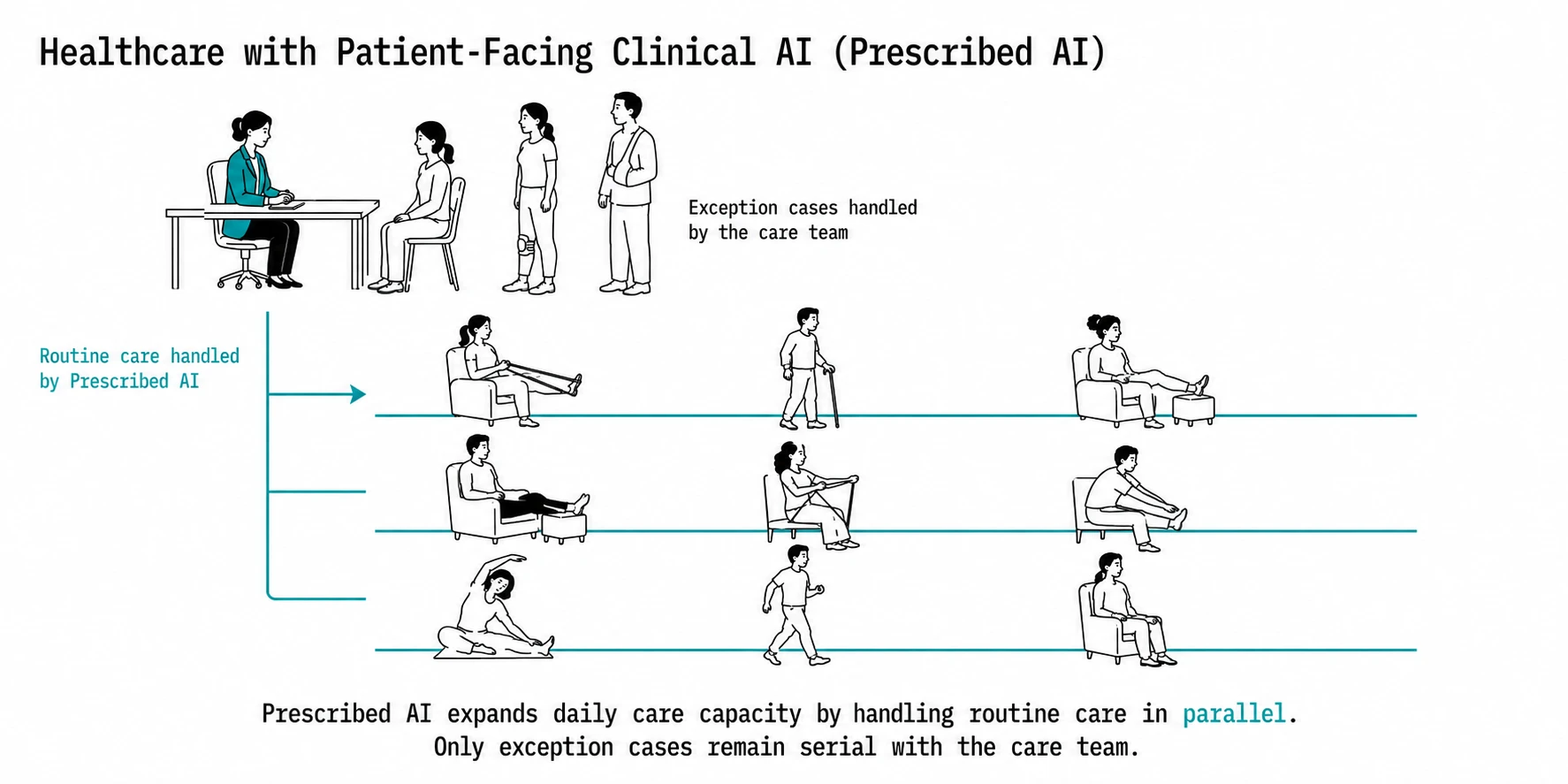
This is the reason RecovryAI took the regulatory path it took. We have spent more than two years and numerous formal FDA meetings pursuing De Novo Class II authorization for a device that makes bounded clinical judgments inside a stated indication for use, because a machine standing in the serial line has to be held to the standard of the person it stands in for. The category we call Prescribed AI, software a clinician orders for a patient the way they would order a medication, exists because of that requirement, and it cannot exist without it.
Gustafson’s Answer
Amdahl’s Law had a famous rebuttal, and it is the optimistic half of this argument. In 1988, John Gustafson of Sandia National Laboratories published “Reevaluation of Amdahl’s Law” in Communications of the ACM.7 His observation: Amdahl assumed the job stays the same size. In practice, nobody buys a thousand processors to run yesterday’s problem faster. They run a bigger problem. When computing gets cheap, the workload expands to use it, and the speedup people actually experience comes from doing far more, well beyond doing the same amount sooner.
Recovery is a Gustafson problem. Today most of a post-surgical recovery goes unwatched: a phone call, a two-week visit, and long stretches where the riskiest days pass with no one looking, because watching is expensive clinician time. If the routine recovery judgment becomes cheap, the honest prediction is Gustafson’s: the supervision expands. Every discharge followed daily instead of episodically. The patient who would have waited too long to call, reached early. The rural county covered where no local clinician had the hours; HRSA projects a 10 percent shortage of registered nurses by 2027, and 24 percent in rural areas.8 The nurses who remain move up the way the bank teller did when the ATM took the cash drawer, from asking the routine question a hundred times a day to handling the patients each morning the machine could not clear.9
Whether that expansion happens in the care path is a question the field will answer with deployment and evidence, and we are early enough to say so plainly. The pattern from computing is consistent: nobody has ever made a scarce, valuable capacity cheap and watched demand stay still.
The One Condition
Both formulas point at the same machine, and the machine carries one hard condition. A system that makes a clinical decision on its own is standing in for a licensed clinician, making a call a trained and accountable person would otherwise make. Software that renders clinical judgments at scale, inside a stated indication for use, is Software as a Medical Device, and it has to be bounded in exactly what it will and will not decide, validated in clinical trials, and authorized by the FDA on the strength of that evidence. Anyone can ship a chatbot that speeds up the parallel work. Standing a device in the serial line is the hard part, and the regulatory work is most of what makes it hard.
Amdahl was right for sixty years about where the limit sits. Gustafson was right about what happens when it moves. The pivotal study now being built is the test of whether a Virtual Care Assistant can move it safely: whether the routine recovery judgment can leave the serial line without the exception ever being missed. That is the number that decides everything else in this essay.
1. Gene M. Amdahl, “Validity of the Single Processor Approach to Achieving Large Scale Computing Capabilities,” AFIPS Spring Joint Computer Conference Proceedings, vol. 30, 1967, pp. 483 to 485. Amdahl was chief architect of the IBM System/360.
2. Scott Walchek, “Two Economists Make the Argument for Virtual Care Assistants,” RecovryAI Dispatch, July 2026, recovry.ai. The economists are William Baumol (with William Bowen, Performing Arts: The Economic Dilemma, 1966; The Cost Disease, Yale University Press, 2012) and William Stanley Jevons (The Coal Question, 1865).
3. Christine Sinsky, Lacey Colligan, Ling Li, et al., “Allocation of Physician Time in Ambulatory Practice: A Time and Motion Study in 4 Specialties,” Annals of Internal Medicine, 2016, 165(11), pp. 753 to 760.
4. Multi-site ambient documentation study of approximately 1,800 clinicians across five academic medical centers, reported by Mass General Brigham and covered by STAT, 2026.
5. Patricia Garcia, Stephen P. Ma, Shreya Shah, et al., “Artificial Intelligence-Generated Draft Replies to Patient Inbox Messages,” JAMA Network Open, 2024, 7(3), e243201.
6. Alan Lam, Chad A. Krueger, et al., study of perioperative communication across 45,216 hip and knee replacements at one high-volume orthopaedic practice, Journal of Bone and Joint Surgery, published May 2026.
7. John L. Gustafson, “Reevaluation of Amdahl’s Law,” Communications of the ACM, 1988, 31(5), pp. 532 to 533. Gustafson was at Sandia National Laboratories.
8. Health Resources and Services Administration, National Center for Health Workforce Analysis, registered nurse workforce projections.
9. James Bessen, Boston University School of Law, research on ATMs and bank teller employment, presented in Learning by Doing: The Real Connection Between Innovation, Wages, and Wealth, Yale University Press, 2015.